 |
| Larawan mula sa Vatican Radio - English Section |

Sunday, April 27, 2014
Maraming nagmamahal sa Santo Papa Juan Paolo II at Santo Juan XXIII!

MABUHAY ang TUNAY na IGLESIA NI CRISTO! DALAWANG PAPA SANTO NA!

SANTO PAPA JUAN XXIII
at
SANTO PAPA JUAN PABLO II
IPANALANGIN NIYO KAMI!
Friday, April 25, 2014
Ang IGLESIA KATOLIKA ay siya pa ring TUNAY na IGLESIA ni CRISTO hanggang sa kasalukuyan ayon sa INC®
 |
| Pope Francis sa kanyang Weekly Audience (Photo Source: UK Foreign & Commonwealth Office) |
Ito ay PINAPATUNAYAN ng magasing "PASUGO" ng nagpapanggap na Iglesia ni Cristo® inilathala ito noong Abril 1966, pahina 46:
“Ang totoo hanggang sa kasalukuyan ay patuloy na ginagawa ni Satanas ang pagpapasok ng mga maling aral sa Iglesia Katolika na sa pasimula'y siyang Iglesia ni Cristo. Sadyang matalino at tuso ang diablo. Hindi niya ginawang biglaan ang pagtalikod sa Iglesiang itinayo ni Cristo noong unang siglo." -Katotohanan Tungkol sa INK-1914
Sa kabuuan, ang pinapatunayan ng INC® ay ganito:
- Hanggang sa kasaluluyan ay Iglesia Katolika pa rin ang tunay na Iglesia ni Cristo sapagkat HINDI pa ito NATALIKOD na ganap!
- Ang Iglesia Katolika ay siyang TUNAY na Iglesia ni Cristo mula pa sa PASIMULA hanggang sa KASALUKUYAN
- Ang Iglesia Katolika ay TATAG ni CRISTO JESUS at hindi si Constantino ayon sa pinangangalat ng kanilang mga Ministro.
- Ang mga PANGAKO ni Cristo na HINDI MANANAIG ang KAPANGYARIHAN ng Hades ay mananatiling MATUTUPAD!
- Ang mga pangako ni Cristo na MANANATILI sa kanyang IGLESIA ay TUTUPARIN niya! Si Cristo ang NANGAKO!
- HINDI tunay ang Iglesia ni Cristo® na tatag ni Felix Manalo noong 1914
Handang Mamatay para kay Cristo at sa kanyang Banal na Iglesia
Kung totoong NATALIKOD na GANAP Iglesia Katolika bilang tunay na Iglesiang tatag ni Cristo, sino ba naman ang nasa kanyang katinuan upang HANDANG mamatay sa isang iglesiang "natalikod na"? Kayo kaya sa INC® ni Manalo, may ministro ba kayong handang MAGBUWIS ng kanyang buhay alang-alang sa Iglesiang® sa tingin niyo ay "tunay"?
Kayo na ang humusga.
 |
| Photo Source: BBCNews |
Heroic Priest Assassinated In Syria
Source: Persecution.org
ICC Note: A 75-year-old Dutch priest paid with his life for choosing to stay and serve the Syrian people. Fr. Frans gave 50 years of his life to serve in Syria and was committed to stay in the city of Homs despite the war going on around them. He felt he could not abandon the few Christians the also remained. He was killed by a masked gunman who came into the monastery and pulled him into the garden and shot him. It is still unclear exactly who is responsible for his assassination... [Ituloy ang pagbabasa rito...]
Panoorin ang balitang ito sa Al-Jazeera Network
Thursday, April 24, 2014


Wednesday, April 23, 2014
SINUNGALING, MANDARAYA at MANLILINLANG ang mga MINISTRO ng IGLESIA NI CRISTO® upang MAKAHIKAYAT ng AANIB sa KANILA!
Maraming Salamat kay Kuya Advice sa artikulong ito na sinulat niya sa FACEBOOK upang maisiwalat natin ang KASINUNGALINGAN at PANLILINLANG ng mga Ministro ng INC® sa kanilang mga taga-panood!
[Ang orihinal na artikulo ay nakasulat lahat sa malalaking titik kaya’t ito’y isinulat kkong muli.]
PANAWAGAN ko sa mga KABABAYAN kong KATOLIKO na NAKIKINIG at NANONOOD ng PROGRAMA ng IBANG SEKTA
***
MGA KAPATID KO SA KATOLIKO.....
WAG na WAG ho kayong MANINIWALA sa KASINUNGALINGANG sinasabi ng PROGRAMA ng INC-1914.. sa NET 25..
Ito ang PROGRAMA nilang "ANG PAGBUBUNYAG"
May mga LIBRO silang BINABASA na NAGPAPATUNAY daw na SUMASAMBA raw sa REBULTO ang mga KATOLIKO..
PANSININ niyo ang PANDURUGAS nila!
MAKIKITA niyo sa LARAWAN sa IBABA.. IPINAGDIKIT ko ang TOTOONG SINASABI ng LIBRO doon sa KASINUNGALINGAN nila..
Kung MAPAPANSIN niyo.. kapag may BINABASA silang libro HINDI NILA PINAPAKITA ang SCAN ng libro.. BAGKUS ay BINABASA LANG NILA ay ang NAKASULAT SA TV SCREEN... WITHOUT SCAN..
Katulad ng librong "CATESISMO" tinagalog ni "PADRE LUIZ DE AMEZQUITA" page 79-82
PANSININ NIYO ang PANDURUGAS nila!
Sabi nila sa kanilang PROGRAMA.. GANITO DAW ang ating MABABASA sa libro "pagbangon mo sa banig ay agad kang maninuklod sa harap ng isang krus o isang mahal na larawan. kung manininuklod ka sa harap ng altar mag wika ka ng ganito: SINASAMBA KITA!"
****
Pero MAPAPANSIN NIYO doon sa scan ng libro ni Padre Amezquita na makikita niyo sa ibaba mula PAGE 79 hanggang 82 ... WALA TAYONG MABABASA na "SINASAMBA KITA"

Wala ho tayong MABABASA na PATUNGKOL sa PAGSAMBA sa LARAWAN.. isa yang KASINUNGALINGAN ng PROGRAMA nila!
At isa pang libro na BINABASA NILA ay ang librong "ANG PANANAMPALATAYA NG ATING MGA NINUNO" na sinulat ni “JAMES CARDINAL GIBBON" page 200..
AYON SA INC.. GANITO DAW ANG ATING MABABASA sa LIBRO
"Sa ganitong kahulugan, sa pagkakilala ko, bumabanggit ang mga manunulat na escolastico hinggil sa gayon ding pagsambang iniuukol sa mga larawan ni Kristo na parang kay Kristong Panginoon natin na rin; sapagkat ang gawang kung tawagin ay pagsamba sa isang larawan ay tunay na pagsamba kay Kristo na rin, sa pamamagitan ng pagyukod sa harap ng larawan na parang sa harap ni Kristo na rin"
****
Diya sa LIBRO ni CARDINAL GIBBON .. TOTOONG may nakalagay na ganyan
PERO PANSININ NIYO ang PANDURUGAS nila!.
BINAWASAN NILA ang NAKASULAT!
Ayon doon sa SCAN na libro ni CARDINAL GIBBBON na NAKIKITA niyo sa ibaba .. kung BABASAHIN niyo ng BUO!

HINDI SIYA ang NAGSASALITA DOON kundi "SINIPI" lang ni CARDINAL GIBBON ang WINIKA ng isang "PROTESTANTE"
PROTESTANTE ho ang NAGSASALITA at HINDI si FATHER GIBBON.. SINIPI lang ni Cardinal Gibbon ang SINABI ng isang PROTESTANTENG si "LEIBNITZ"
PINAPALABAS NILA na si CARDINAL GIBBON ang NAGSASALITA.. Isa yang PANDURUGAS para MAKAPANLOKO ng tao at para MALINLANG ang mga KATOLIKO!!
NARITO PO ANG SADYANG PINUTOL NILA!
"Though we speak of honor paid to images, yet ,this in only a manner of speaking, which really means that we honor not the senseless thing which is incapable of understanding such honor, but the prototype, which receives honor through its representation, according to the teaching of the Council of Trent."
MALINAW po diyan na ang TINUTUKOY na "HONOR PAID TO IMAGES" ay "ONLY A MANNER OF SPEAKING" o salita lang. Hindi totohanan at HINDI aktwal..
Eto pa po.. "WE HONOR NOT THE SENSELESS THING.. BUT THE PROTOTYPE”
HINDI raw po yung WALANG KWENTANG BAGAY ang DINADAKILA kundi ang IPINAPAALALA niyon o NIREREPRESENTA at PINAPAHIWATIG..
Walang PINAGKAIBA ho sa SINASABI ng libro nating mga Katoliko "CATECHISM OF THE CATHOLIC CHURCH" about sa paggamit ng images
CCC-2132
70 - The honor paid to sacred images is a "respectful veneration," not the adoration due to God alone:Religious worship is not directed to images in themselves, considered as mere things, but under their distinctive aspect as images leading us on to God incarnate. The movement toward the image does not terminate in it as image, but tends toward that whose image it is.
Kitams.. IYAN ang TOTOONG ARAL nating mga Katoliko.. ang REBULTO ho katulad ng ni Hesus ay HINDI natin SINASAMABA dahil ang PAGSAMBA ay sa DIYOS LAMANG!
Ang SINASAMBA NATIN ay yung NIREREPRESENTA at PINAPAHIWATIG ng REBULTO ni HESUS.. HINDI ang MISMONG rebulto
At about naman sa mga SANTO .. SILA ay PINAPARANGALAN lang natin dahil SILA ay katulad nating SUMASAMBA din sa ating PANGINOONG DIYOS
UTOS ng PANGINOON na DAPAT ay ALALAHANIN natin sila
HEBREO 13:7
Alalahanin ninyo ang mga dating NAMUMUNO sa inyo, ang mga NAGPAHAYAG SA INYO NG SALITA NG DIYOS. Isipin ninyo kung paano sila namuhay, at TULARAN ninyo ang kanilang pananampalataya sa Diyos.
SEE.. INUTOS pa sa atin na TULARAN NATIN SILA .. dahil saila ay TOTOONG NAGMAMAHAL sa DIYOS ay NAGBUWIS ng BUHAY dahil sa PAGMAMAHAL nila sa DIYOS
**********
KINDLY LIKE AND SUPPORT KUYA ADVISER in FACEBOOK
FOR MORE CATHOLIC APOLOGETICS
Sunday, April 20, 2014
MALIGAYANG PASKO ng MULING PAGKABUHAY! ALELUYA!
Isang pagbati po ng Maligayang Pasko ng Pagkabuhay sa lahat ng mga kaanib ng
TUNAY na IGLESIA NI CRISTO
ang IGLESIA KATOLIKA!

Friday, April 4, 2014
Ang 21 Konseho Ecumenico ng Iglesia ni Cristo
 |
| Ang Ikalawang Conseho ng Vatican (Larawan mula sa Catholics On Call) |
1. The First Council of Nicaea (A.D. 325)
This Council, the first Ecumenical Council of the Catholic Church, was held in order to bring out the true teaching of the Church as opposed by the heresy of Arius. It formally presented the teaching of the Church declaring the divinity of God the Son to be one substance and one nature with that of God the Father. There were twenty canons drawn up, in which the time of celebrating Easter was clarified and a denunciation of the Meletian heresy made, also various matters of discipline or law were dealt with and several decisions advanced. From this Council we have the Nicene Creed.
2.The First Council of Constantinople (A.D. 381)
Again the true faith was maintained against the Arians. Answer was also given against the Apollinarian and Macedonian heresies. In answering the latter which denied the Godhead of the Holy Spirit, the dogma of the Church was again stated and the words inserted into the Nicene Creed declaring the truth that the Holy Spirit proceeded from both the Father and the Son.
3. The Council of Ephesus (A.D. 431)
The third General Council of the Church defined the Catholic dogma that the Blessed Virgin is the Mother of God and presented the teaching of the truth of one divine person in Christ. The Council was convened against the heresy of Nestorius.
Sunday, March 30, 2014

Wednesday, March 26, 2014
Dating Sabadista ngayo'y kaanib na ng Iglesia ni Cristo - Kwento ni Jason Liske
Si Felix Manalo po, ang nagtatag ng kanyang sariling Iglesia (INC) na minsa'y naging pastor ng mga Sabadista ay maraming mga patotoong hango kay Ellen G. White, ang tagapagtatag ng The Seventh-Day Adventists o mas kilala sa pangalang "Sabadista".
Narito po ang kwento ni Jason Liske mula sa Ascent of Carmel blog kung saan inilalahad niya ang lasong sumira sa kanyang tiwala sa tunay na Iglesia ni Cristo-- ang Iglesia Katolika!
My Journey From Seventh-Day Adventism to the Catholic Church
 |
| Ellen G. White |
I've been told that to go from being a Seventh-Day Adventist to a Catholic Christian is quite the leap. It really is - the Adventist movement is so very Protestant that it even views Protestants as in error.
If you're unfamiliar with Adventism, let me give you a brief primer: it has essentially morphed into an evangelical movement, but it originally began as a restorationist-style outgrowth of its time. Its chief distinguishing marks are the observance of the Jewish Sabbath (Saturday), vegetarianism and healthy living, a heavy focus on the Second Coming of Christ and apocalyptic eschatology, and a peculiar prophetess named Ellen G. White. All of these aspects of the tradition one can search out for themselves.
But what is highly bizarre when I look back on it is the fact an Adventist would become a Catholic. A quick investigation into the history and doctrines of Adventism reveals it at once to be extremely antagonistic towards the Catholic Church. In fact, it is so very much so, that it refers to the Church in all manner of malicious terms - the Beast, the harlot, Babylon, the antichrist, and the like. Moreover, I remember being taught that the Catholic Church would enact Sunday laws that would force Adventists to worship on Sunday.
This is the faith that I grew up in. Over time, the Catholic Church turned into a terrifying and dark force in my view. The imagery of it all I viewed as garish and gorey, guilt-inducing and meant to frighten. As a child, I viewed the Mass as a place of bizarre repetitious chanting where the laity wore white robes and understood very little of what was going on. Catholics drank and smoked, and for an Adventist like myself, this I viewed as shocking for Christians to do. To top it all off, there was the Pope, sitting on his evil throne in Rome, just biding his time before launching some kind of world-wide new world order of persecution.
Saturday, February 22, 2014
Hinirang na mga bagong Cardinal ng Iglesia ni Cristo sa Roma
Sa aking nakaraang artikulo noong Enero 22, 2014 nabanggit ko roon ang pagkakaroon ng mga bagong Cardinal ng Santa Iglesia at kahapon nga ay hinirang ang may 19 na bagong Cardinal.
Narito ang mga hinirang na bagong Cardinal mula sa iba't-ibang sulok ng mundo na inaabangan ng mga mamamahayag:
Vatican
- Pietro Parolin, Titular Archbishop of Acquapendente, Secretary of State
- Lorenzo Baldisseri, Titular Archbishop of Diocleziana, Secretary General of the Synod of Bishops
- Gerhard Ludwig Mueller, Archbishop-Bishop emeritus of Regensburg, Prefect of the Congregation for the Doctrine of the Faith
- Beniamino Stella, Titular Archbishop of Midila, Prefect of the Congregation for the Clergy
Europe
- Vincent Nichols, Archbishop of Westminster, United Kingdom
- Loris Francesco Capovilla, Titular Archbishop of Mesembria (Bulgaria)
- Fernando Sebastian Aguilar, C.M.F., Archbishop emeritus of Pamplona (Spain)
- Gualtiero Bassetti, Archbishop of Perugia-Citta della Pieve, Italy
Latin America
- Leopoldo Jose Brenes Solorzano, Archbishop of Managua, Nicaragua
- Orani Joao Tempesta, O.Cist., Archbishop of Rio de Janeiro, Brazil
- Mario Aurelio Poli, Archbishop of Buenos Aires, Argentina
- Ricardo Ezzati Andrello, S.D.B., Archbishop of Santiago del Cile, Chile
North America & Caribbean
- Gerald Cyprien Lacroix, Archbishop of Quebec, Canada
- Chibly Langlois, Bishop of Les Cayes, Haiti
- Kelvin Edward Felix, Archbishop emeritus of Castries (Saint Lucia)
Africa
- Jean-Pierre Kutwa, Archbishop of Abidjan, Ivory Coast
- Philippe Nakellentuba Ouedraogo, Archbishop of Ouagadougou, Burkina Faso
Asia
- Andrew Yeom Soo jung, Archbishop of Seoul, South Korea
- Orlando B. Quevedo, O.M.I., Archbishop of Cotabato, Philippines
Kuwentong Pagbabalik-loob ni Alfie J. Angeles - Dating ADD, lumipat sa INC® ngayo'y Katoliko na!
 |
| Seminarista Alfie J. Angeles |
THE STORY OF ALFIE ANGELES
Catholic-turned-ADD-turned-INC. At home at last.
Story extracted from The Splendor of the Church Blog of Fr. Abe
“Life not spent in serving the Lord is a life lived in vain.”
Ako ay isinilang noong January 6, 1982 ng mag-asawang Domingo Mangalindan Angeles at Marina Rosco Jugal sa maliit na bayan ng Montalban, Rizal na tinatawag ngayong Rodriguez, Rizal. Nang makilala ng aking ama ang aking ina, ang aking ina ay mayroon nang dalawang anak sa una niyang asawa. Sila ay sina Michael at Marlon Ortazo. Nang una, ang aking mga magulang ay naninirahan sa bahay ng nanay ng aking ama sa Burgos, Rodriguez, Rizal, subalit dala ng pag-uusig noong una ng ilang kapatid ng aking ama ay nagpasya silang manirahan nang bukod sa isang bukid na sinasaka ng aking ama. Dito ay napatunayan ng aking ina na sa hirap man ay maaasahan ng aking ama ang pagtulong ng aking ina. Hindi naman naglaon ay natanggap ng mga kapatid ng aking ama ang aking ina. Ako ay naiwang kasama ng aking lola na si Teodora M. Angeles na kung saan doon ako lumaki at nagkaisip. Tuwing Sabado at bakasyon ay lagi akong pumupunta sa bukid ng aking ama.
Sa murang edad, natuto akong magtinda ng gulay na inaani ng aking mga magulang. Sumasama rin ako sa aking ina sa pagtitinda ng gatas ng kalabaw. Lahat ng aking kinikita ay ibinibigay ko sa aking lola. Ang lola ko naman ang nagbibigay ng baon sa akin araw-araw.
Taong 1988 ay naoperahan ako dahil sa appendicitis. Dito una kong nalaman ang aking pagkahilig sa relihiyon. Natatandaan ko pa noong ako ay hindi pa nag-aaral, ako ay hinanap ng aking mga pinsan at hindi nila ako matagpuan. Makalipas ang ilang oras ay natagpuan nila ako sa simbahan ng Señor de Burgos sapagkat naging ugali na namin noon na sa tuwing darating ang Sabado ay nagsisimba kami. Napansin ko kasi na hapon na ay hindi pa gumagayak ang aking mga pinsan kaya ipinasya kong mauna na sa kanila.
Naging miyembro rin ako ng choir ng Señor de Burgos noong ako ay grade six. Ako ang nanguna sa aming mga magpipinsan sa pag-aaral kung paano magdasal ng rosaryo. Ang mga kabataan sa amin ay naging hilig ang pagdarasal ng rosaryo lalo na noong panahong iyon ay wala pang kuryente sa aming lugar.
Ako ay nag-aral sa Burgos Elementary School Unit I, mula grade 1 hanggang grade 4 at ako ay nagkamit ng ikalawang karangalan at maging sa pagguhit ay nakilala ako, subalit nang ako ay lumipat sa Burgos Elementary School Main, ay hindi na ako nagkamit pa ng karangalan.
Buhay High School
Ako ay nag-aral sa Doña Aurora High School isang pribadong paaralan sa San Mateo. Dito nagpasimula ang aking hilig sa relihiyon. Natuto rin akong makisalamuha sa iba’t ibang tao. Dito rin ako natutong makipagkaibigan at makibagay. Tinatawag nila akong “father” sapagkat nang magtanong ang aking 1st year high school teacher na si Mrs. Sarita kung ano ang nais namin paglaki namin, ang sinabi ko ay nais kong maging isang pari. Maituturing ko ngang coincident o premonition ang nangyari sapagkat ang iginuhit kong pari ay isang Franciscan priest.
Ang unang pagsusuri sa relihiyon
Taong 1995, may pumasyal sa aming mga misyunero ng simbahan ng Mormons. Inanyayahan nila akong makinig sa gagawin nilang pag-aaral. Ako ay nagpasyang mag-aral sa kanilang relihiyon dahil sa kuryosidad sapagkat ang aking mga pinsan noon ay sumama na sa ibang relihiyon. Ako ay nabautismuhan sa relihiyon ni Mormon taong February 1995 subalit hindi ako nagtagal sapagkat ibang-iba ang kanilang mga seremonya na bilang batang bagong anib sa kanilang relihiyon ay hindi magugustuhan ang sistema. Hindi ko na rin napagtiisan ang kanilang mga kakatwang doctrina.
Ang ikalawang pagsusuri sa relihiyon
Dala ng panghihikayat ng aking kamag-anak at kababata noon, ako ay sumama sa relihiyon ng aking pinsan, ang Iglesia ng Dios kay Cristo Jesus, Haligi at Suhay ng Katotohanan (IDCJHSK) na dito ay higit akong naging masaya sapagkat ang mga kaanib ay matanda lamang ng kaunti sa aking edad. Dito ay nahubog ang aking pagiging isang tao dahil ako ay nasa panahong tinatawag na formative years. Naanib ako rito noong March 30, 1996. Pinag-aralan ko rin ang relihiyong ito, at gaya ng dati, mga kakatwang doctrina ang sumalubong sa akin gaya ng pagpapahaba ng buhok ng babae na hindi maaaring putulin. Ako ay nagtagal na aktibo sa samahang ito ng isang taong mahigit.
Taong 1998, ako ay nagtapos sa High School, kasabay nang aking tuluyang pag-iwan sa samahang ito.
Ang ikatlong pagsusuri sa relihiyon
Noon ay unti-unting sumisikat ang samahang Ang Dating Daan (ADD). Ang lider ng relihiyong ito na si G. Eliseo F. Soriano ay nanggaling rin sa relihiyong aking inaniban, ang IDCJHSK kaya ako ay nagkaroon ng interes na alamin ang kanilang paniniwala. Nagkaroon rin ako ng interes sa relihiyong ito dahil sa kakaibang uri ng panghihikayat niya ng mga tao na makinig sa kanya. Ito rin ang panahon na ako ay pumasok sa kolehiyo.
Taong 2009 naman ay pumanaw ang tanging kasama ko sa bahay, at taong nag-alaga sa akin na totoong ipinagdamdam ko ng lubusan ang kanyang paglisan, ang aking lola.
Friday, February 21, 2014
Ang malinaw na PANDARAYA ng mga MINISTRO ng Iglesia ni Cristo®!
[Article taken from the Iglesia ni Cristo 33-A.D. Blog]
Narito na naman ang isang malaking PANLILINLANG ng mga kaanib ng INC ni Manalo sa kanilang opisyal na YouTube. Hindi lang nila NILINLANG ang kanilang mga sarili kundi maging ang kanilang mga kaanib at mga tagapanood.
Narito po ang munting sulyap kung ano at sino ba ang mga Apostolic Catholic Church na ito?
Narito na naman ang isang malaking PANLILINLANG ng mga kaanib ng INC ni Manalo sa kanilang opisyal na YouTube. Hindi lang nila NILINLANG ang kanilang mga sarili kundi maging ang kanilang mga kaanib at mga tagapanood.
Una po, itong taong sinasabi nilang dating pari ay HINDI PO tunay na pari sa IGLESIA KATOLIKA. Isa po siyang pari ng isang denominasyong nagpapanggap na Katoliko.
Si Mr. Christopher Yu po ay dating kaanib ng "Apostolic Catholic Church of Beloved Ingkong, Inc." isang Protestanteng iglesiang may katunog na pangalan at HINDI po siya affiliated sa Vatican. Maari nating maihalintulad sa "Independente" ang kanilang iglesia. Kaya't malaking PANLILINLANG po sa kanilang mga kaanib at tagapanood na sabihin nilang si Mr. Yu ay isang paring "Katoliko".
 |
| Logo ng ACC |
Narito po ang munting sulyap kung ano at sino ba ang mga Apostolic Catholic Church na ito?
Pangalan: Apostolic Catholic Church of Beloved Ingkong
Polity: Episcopal
Leader: John Florentine L. Teruel
Founder: John Florentine L. Teruel and Maria Virginia Peñaflor Leonzon
Origin: July 7, 1992
Place: Philippines Hermosa, Bataan, Philippines
Separated from Roman Catholic Church
Members: unknown
Official website: http://www.acc-ingkong.org/
Alam niyo ba kung ilan ang mga kaanib ng tunay na Iglesia sa buong mundo?
 |
| Photo from Catholicism Series |
Sa katunayan ay patunay raw na "kinasisihan" ng Dios ang kanilang relihiyon sapagkat dumarami raw ang kanilang mga kaanib.
Kung ang batayan pala ng pagpapatunay na sa Dios o hindi sa Dios ang isang relihiyon ay ayon sa dami ng kaniyang kaanib, lalong lumalabas na ang Iglesia Katolika pa rin ang TUNAY sapagkat ayon sa istatistika, ang Iglesia Katolika ang siyang may pinakamalaking bilang ng mga kaanib sa LAHAT ng mga relihiyon sa buong mundo.
Ayon sa Adherents.com, Katoliko pa rin ang may pinakamalaking bilang ng kaanib:
The Catholic Church is the world's largest religious body. The lists below indicate places that are "most Catholic" or places with large numbers of Catholics.
Ito naman ang sinasabi ng CIA tungkol sa Iglesia Katolika:
Catholicism (or Roman Catholicism): This is the oldest established western Christian church and the world's largest single religious body. It is supranational, and recognizes a hierarchical structure with the Pope, or Bishop of Rome, as its head, located at the Vatican. Catholics believe the Pope is the divinely ordered head of the Church from a direct spiritual legacy of Jesus' apostle Peter. Catholicism is comprised of 23 particular Churches, or Rites - one Western (Roman or Latin-Rite) and 22 Eastern. The Latin Rite is by far the largest, making up about 98% of Catholic membership. Eastern-Rite Churches, such as the Maronite Church and the Ukrainian Catholic Church, are in communion with Rome although they preserve their own worship traditions and their immediate hierarchy consists of clergy within their own rite. The Catholic Church has a comprehensive theological and moral doctrine specified for believers in its catechism, which makes it unique among most forms of Christianity.
Top 10 Nations with
Most Catholics
| Nation | Percent | Number of baptized Catholics |
|---|---|---|
| Brazil | 86.50% | 134,818,000 |
| Mexico | 95.30 | 86,305,000 |
| USA | 26.00 | ~61,000,000 |
| Philippines | 83.60 | 58,735,000 |
| Italy | 97.20% | 55,599,000 |
| France | 82.10 | 47,773,000 |
| Spain | 94.20 | 36,956,000 |
| Poland | 95.40 | 36,835,000 |
| Colombia | 91.90 | 32,260,000 |
| Argentina | 90.70 | 31,546,000 |
| Germany | 34.80 | 28,403,000 |
Source: 1998 Catholic Almanac: Our Sunday Visitor: USA (1997), pg. 333-367. Except U.S. figures, which are from general sources.
Heto naman ang ayon naman sa Wikipedia:
The Catholic Church, also known as the Roman Catholic Church, is the largest Christian church, with 1.2 billion baptised members.
Thursday, February 20, 2014
Panawagan ng Santo Papa sa mga Pentecostals!
Sa kapulungan ng mga Pentecostals (Evangelical groups) na idinaos sa Estados Unidos, nanawagan ang kanyang kabanalan, Papa Francisco ng Iglesia ni Cristo tungo sa Pagkakaisa ng Lahat ng Kristiano.
Narito ang kanyang mensahe (salamat sa link mula sa Catholic World Report):
Narito ang pahayag ng nag-upload ng video:
"Pope Francis recorded a message of reconciliation and unity between the Catholic Church and the Evangelical Church for Kenneth Copeland Ministries, a group of Pentecostal Christians in the United States. Bishop Tony Palmer, a bishop from a Pentecostal Christian community, did the camera work with an iPhone. The bishop also serves as international ecumenical officer for the Communion of Evangelical Episcopal Churches, a group that is not affiliated with the Anglican Communion, and which takes a much simpler view of the path to full Christian unity than the pope and the mainline Christian churches do. The translation used for the English subtitles on the video are not precise, but the pope's sincerity is clear."
Wednesday, February 19, 2014
KIM YU-NA, Koreana! Katoliko! Olympian!
Nakakatuwang isipin na ang isa sa mga hinirang na kampion sa nakaraang Sochi Olympics 2014 sa Sochi, Russia ay walang iba kundi si KIM YU-NA ng Korea.
Si Ms. Yu-Na ay ipinalaking Katoliko ng kanyang mga magulang. At sa tuwing siya'y sumasali sa mga kumpetisyon sa larangan ng sports siya'y panandaliang nananalangin sa pamamagitan ng pag-ANTADA ng banal na KRUS.
Hindi siya katulad ni Manny Pacquiao na nagku-krus noon ngunit di kalauna'y nasilaw sa yaman at kapangyarihan at tinalikuran ang pananampalatayang nagpanalo sa kanya.
Ipagmalaki natin si Kim Yu-An na sana'y manatili siyang matatag sa kanyang pananampalatayang Katoliko at manatiling inspirasyon ng mga kabataas sa Korea at sa buong mundo.
Mabuhay ka Kim Yu-Na, ipinagmamalaki ka ng buong Santa Iglesia Katolika! Ang tunay na Iglesia ni Cristo!
PANLILINLANG ng pekeng IGLESIA (raw) ni Cristo
Narito na naman ang isang malaking PANLILINLANG ng mga kaanib ng INC ni Manalo sa kanilang opisyal na YouTube. Hindi lang nila NILINLANG ang kanilang mga sarili kundi maging ang kanilang mga kaanib at mga tagapanood.
Narito po ang munting sulyap kung ano at sino ba ang mga Apostolic Catholic Church na ito?
At hinggil naman sa kanilang quotations galing kay Cardinal James Gibbons ay isang malaking panlilinlang na labas sa Sampung Utos ng Dios "Thou shalt not bear false witness against thy neighbor."
Ganyan ba ang "iglesiang" aaniban niyo? Ang gumagamit ng PANLILINLANG upang manghikayat ng bagong kaanib? Tandaan, tanging si Satanas lamang ang ama ng panlilinlang! At yan na nga po ang INC ni Manalo sa Pilipinas!
Una po, itong taong sinasabi nilang dating pari ay HINDI PO tunay na pari sa IGLESIA KATOLIKA. Isa po siyang pari ng isang denominasyong nagpapanggap na Katoliko.
Si Mr. Christopher Yu po ay dating kaanib ng "Apostolic Catholic Church of Beloved Ingkong, Inc." isang Protestanteng iglesiang may katunog na pangalan at HINDI po siya affiliated sa Vatican. Maari nating maihalintulad sa "Independente" ang kanilang iglesia. Kaya't malaking PANLILINLANG po sa kanilang mga kaanib at tagapanood na sabihin nilang si Mr. Yu ay isang paring "Katoliko".
|
| Logo ng ACC |
Narito po ang munting sulyap kung ano at sino ba ang mga Apostolic Catholic Church na ito?
Pangalan: Apostolic Catholic Church of Beloved Ingkong
Polity: Episcopal
Leader: John Florentine L. Teruel
Founder: John Florentine L. Teruel and Maria Virginia Peñaflor Leonzon
Origin: July 7, 1992
Place: Philippines Hermosa, Bataan, Philippines
Separated from Roman Catholic Church
Members: unknown
Official website: http://www.acc-ingkong.org/
 |
| Ang sambahan ng Apostolic Catholic Church Ina Poon-Bato sa Quezon City |
On the topic on the veneration of images, Gibbons has previously stated the official teaching of the Catholic Church by quoting the Council of Trent which says: “The images of Christ and of His Virgin Mother and of the other saints are to be had and retained especially in churches and a due honor is to be given them NOT BECAUSE any virtue or divinity is believed to be in them that for which they are to be honored, nor any prayers be made to them, nor do we placed our hope in them as what the heathens do who placed their hopes in idols BUT BECAUSE the honor which is given them is referred to the originals which they represent.” If you read slowly, you will notice that although the Church teaches her children to honor sacred images but the reason for doing so is not because we ascribe any power, virtue or divinity to them (which is what the pagans do as can be found in many biblical passages condemning idolatry) but this honor is only relative which means that this is done in their relation to the originals represented. This attitude is very much like the manner we treat the statues of our national heroes and statesmen. The honor given to their statues and monuments are referred to the persons being represented. When a husband kisses his wife’s picture no one will be so foolish as to think that the man is in love with a dead picture (unless the man is a fool) but we instinctively would say that the particular act of affection is directed to the wife which is represented in the picture. This is what Gibbons meant when he said “the act which is called the worship of an image is really the worship of Christ Himself” no more no less. Now if you try to insert your own interpretation which the Cardinal did not meant to say then you are doing a great injustice to the author you just cited. I remember that in the same book and in the same topic Gibbons warned those who will falsely accuse Catholics of idolatry “Thou shall not bear false witness against thy neighbor.” -Source: The Splendor of the Church Blog
Ganyan ba ang "iglesiang" aaniban niyo? Ang gumagamit ng PANLILINLANG upang manghikayat ng bagong kaanib? Tandaan, tanging si Satanas lamang ang ama ng panlilinlang! At yan na nga po ang INC ni Manalo sa Pilipinas!
Thursday, February 6, 2014
Dr. Wesley Vincent Ph.D. - Bagong Kaanib ng Iglesia ni Cristo
Isa na namang kwento ng pagbabalik-loob sa Iglesia ng isang Protestante. Dati-rati siya'y "Bible-Only" Christian ang paniniwala niya ngunit sa pamamagitan ng masusing pagsusuri sa katotohanang katangian ng tunay na Iglesia ni Cristo ay napatunayan niyang ang Santa Iglesia Katolika ay Biblical at ang kanyang itinuturo ay taliwas sa paniniwala ng mga Protestante. Sa awa at tulong ng Banal na Espiritu ay naibalik na sa tunay na Iglesia si Dr. Wesley Vincent, Ph.D. at ng kanyang pamilya.
A Bible-Believer Becomes Catholic by Believing the Bible – Conversion Story of Wesley Vincent Ph.D.
A Bible-Believer Becomes Catholic by Believing the Bible – Conversion Story of Wesley Vincent Ph.D.
Source: CHNetwork.org

Our devout, fundamentalist-evangelical family of six children attended Sunday School, Sunday morning and evening worship services, Wednesday evening prayer meeting, and choir rehearsal after prayer meeting — even when traveling. My parents alternately took us to Nazarene and Baptist congregations. Nazarenes taught Arminian doctrine; that sinning resulted in loss of salvation. Baptists taught “once saved – always saved – safe and secure for eternity.” As early as grade school I became aware that different denominations taught contradictory doctrines, yet logic dictates that only one can be correct. Fundamentalist-evangelical pastors taught the precepts: (1) the Bible is the only authority; (2) salvation is by faith alone; and (3) the requirement to live according to biblical morality while simultaneously believing that our actions (works) had nothing to do with salvation. Fundamentalists erected legalistic barriers around immoral behavior in order to avoid any occasion for temptation.
I never remember not believing in Jesus Christ, though our family had faith, we were not happy. There was, however, one bright spot in my childhood: Bible Club.
The late Allan Emery, Jr. and his wife, Marian, held Bible Club in their living room for 50 to 90 teenagers every Thursday night. Allan was President and Chief Operating Officer of the Billy Graham Evangelistic Association. These loving Christians made everyone feel special and welcome at Bible Club — Protestant, Catholic, or un-churched. On alternate weekends, twelve teens were taken to Whisperwood, their New Hampshire farm, for weekend retreats. The strict rule was no more than two weekends, per teen, each year. One year, because the Emerys knew about each teen’s home life, every weekend they found a way to “need” one more boy. I was that fortunate boy. The Emery’s personal commitment led me to view them as being “Christ to me.” Bible Club was a godsend where my first happy memories were formed and where I met, courted, and (in 1975) married Paula (the perfect girlfriend) in the Emery’s flower garden.
Innate desires
Besides Bible Club, two other childhood factors influenced my faith journey. I had an intense yearning to participate in communion, but to receive communion in my childhood church required being twelve years of age, baptized, and a member. After communion one Sunday, at about age eight, I discovered that the communion trays of Matzo crackers and cups of grape juice were left unattended in the kitchen. On subsequent communion Sundays, after the ushers returned from disposing of the trays, I would ask to use the restroom and proceed to reverently serve myself communion. When our family moved to a new congregation, communion was infrequent. Later, as a busy student at Wheaton College, the congregation I attended never seemed to have communion, yet my deep desire for communion never faded.
Besides a desire for communion, I was drawn to the story of Christ’s birth and the Ave Maria (my mother’s favorite music). Our beautiful (Catholic) Advent Calendar was a treasured Christmas tradition; however, because my mother was the choir director in all the congregations we attended, and my father was a deacon, we children were advised never to discuss these topics with other members. None of the congregations we attended were open to ecumenism with other Protestant denominations and utterly rejected the Catholic Church. The serene image of Mary brought a sense of peace to me, especially as a child in an unhappy family. Interestingly, the Emerys were the only Protestants I knew who openly recognized Catholics as Christians. Although Paula, who was Catholic, joined me in Protestant congregations, the Emerys never encouraged her to leave the Catholic Church.
A jigsaw of interpretation
Living with many mutually contradictory doctrines made understanding the faith similar to trying to complete a complex puzzle from a combination of different jigsaw puzzles stirred together. As a teen I viewed the contradictions with perplexity. For example, altar calls in the Nazarene congregations (when only members were present) made sense based on the Arminian doctrine of the possibility of losing one’s salvation. However, in the “once saved – always saved – safe and secure for eternity” Baptist congregations, altar calls to members seemed utterly absurd. In one congregation, this only impacted one mentally feeble woman who tearfully went forward each time and “finally accepted Jesus — again.” As an adult, maintaining the theological tension between contradictory biblical interpretations eventually led to a minimalistic faith. That is, the acceptance of Jesus was the only necessary aspect of the faith; nothing else mattered. So after college, since both Paula and I were employed at different evangelical agencies with weekly chapel services led by pastors and missionaries, we readily substituted the chapel services for Sunday attendance. But there persisted a desire to find a church that taught all of what we knew Scripture taught.
In 1979, a move to a small New England town resulted in a limited choice of congregations. Two of the local congregations were so theologically liberal that the pastors were more likely to quote sentimental poems than Scripture. One fundamentalist congregation was pastored by a high school graduate whose exegesis was agonizingly embarrassing. Another congregation was so unreceptive to newcomers that not a single member of the congregation, or the pastor, greeted us.
Discounting the Catholic church in town, Paula and I hesitantly visited the remaining small Episcopal chapel. The beauty of the liturgy and the opportunity to receive communion at every service was such a blessing that that congregation became our spiritual home. Two years later, in 1981, we moved again for graduate school and attended a large, active, Episcopal congregation with dynamic liturgy, powerful sermons, and some of the best music we have ever enjoyed. Yet, sadly, it was in that congregation where it became evident that, while the words were biblical, a double-speak was at play. The realization that something was amiss occurred after learning that the rector’s “wife” was actually still married to an ex-parishioner. Gradually, it became evident the evangelical and biblical language was actually code for left-leaning political messages.
Without describing every issue, my Protestant experience confirmed that there was no congregation in which I could trust that all (or only) biblical truth was being taught. Certainly, much truth was taught at all the congregations we attended, but never was “all truth” (Jn 16:12) taught. In fact, it took only a few sermons to identify some false, unbiblical doctrine being proffered. It became increasingly evident that every pastor and member — not the Bible — was his or her own final authority. Utter discouragement with the contradictory theological doctrines led us to live our faith on our own for more than two decades. During that time many evangelical clients came to my practice specifically because I am listed with insurance companies as a Christian psychologist. Often, what these clients believed and practiced was foreign to what I previously knew to be evangelicalism. This made it apparent that evangelicalism had changed radically during those two decades. Many aspects of moral living were also conspicuously absent.
“Correcting” Scripture
These experiences made it obvious that the “once saved – always saved – safe and secure for eternity” doctrine was “a different gospel” (Gal 1:6-7). The carefully guarded and entrenched belief regarding their prerogative to a personal, private interpretation of Scripture insulated these individuals from recognizing the fallacy of their beliefs and practices. I came to recognize that the schismatic nature of Protestant denominations is likely due to this non-biblical and faulty assurance that individual believers are guaranteed to be led into “all truth” (Jn 16:12). Yet, as I later discovered, Scripture is clear that only the Apostles, individually (Jn 16:12), and “God’s household, which [is] the Church of the Living God, the pillar and bulwark of truth” (1 Tim 3:15) were given any assurance of acquiring “all truth.”
Tuesday, January 14, 2014
ALAM NIYO BA: San Ignatius ng Antioch - Unang nagbansag sa Iglesia ni Cristo bilang Iglesia Katolika
Alam niyo ba kung saan at kailan unang tinawag ng mga "Kristiano" ang mga taga-sunod ni Cristo? At alam niyo rin ba kung saan at kailan naman tinawag ng "Katolika" ang iglesiang itinatag ng Panginoong Hesus?
Ito ay matatagpuan sa Mga Gawa 11:26. Unang tinawag na Kristiano ang mga taga-sunod ni Cristo sa Antioch.
Sa katunayan, hindi naman Kritiano ang katawagan sa mga taga-sunod ni Cristo noon. Nagpakilala ang mga unang taga-sunod ni Cristo bilang mga "disipulo" o mga "estudyante [source: Catholic.com].
Di kalauna'y maraming mga "Kristiano" ang humiwalay sa tunay na katuruan ni Cristo at nagpapakilala ring mga Kristiano. Sila'y gumagamit din ng mga simbulo at ritual na ginagawa ng mga orihinal na mga taga-sunod ni Cristo.
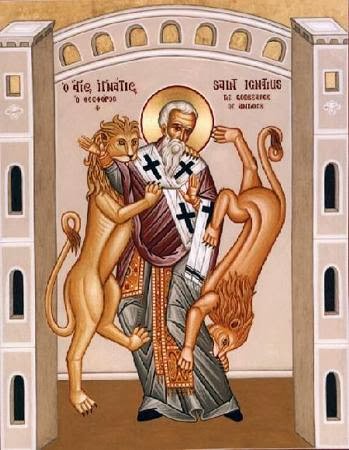 |
| Imahe ni San Ignatius na pinakain sa mga leon (wikipedia) |
Kaya't ang mga salitang kataholos ay lumitaw bilang pagpapakilala sa tunay na Iglesia. Ang ibig sabihin ng salitang kataholos ay kabuuan o pangkalahatan sa wikang Griego. Ang kaisipang ito ay hango sa pangkalahatang paniniwala at pananampalatayang maiuugnay sa buong Kristianismo bilang pangkalahatan, taliwas sa mga "Kristiano" raw ngunit may gawaing hindi naman sinasamapalatayanan ng pangkalahatang Kristianismo. Sa kalauna'y ang kataholoscame ay naging kahulugan ng Ingles na salitang "Catholic".
Sa pamamagitan po ni San Ignatius sa Antioch taong 110 AD din po nagmula ang katawagang "Katoliko" bilang katawagan sa tunay na Iglesia.
Sa mga nagsasabing imbento lamang ni San Ignatius ang mga salitang "Katoliko" o sa mga kaanib ng INC ni Manalo, hindi po bagong salita para sa mga tao noon ang katagang "Katoliko" o "Katolika". Pinapatunayan lamang ni San Ignatius na ang katawagan ng Iglesia bilang Katolika ay katanggap-tanggap na sa kanyang kapanahunan.
At bago pa man sabihin ng mga kumakalaban sa Santa Iglesia ang kredibilidad ni San Ignatius, ating alamin kung sino ba si San Ignatius.
Ayon sa Wikipedia, si San Ignatius ay isa sa mga tinatawag na "Apostolic Fathers". Siya ay ang Obispo ng Antioch noong panahon kapalid ni Apostol San Pedro na noo'y namatay sa Roma taong 64 AD. Disipulo po siya ni Apostol San Juan kaya't ang kanyang pananampalataya ay mas orig kumpara sa mga kaanib ng INC ni Manalo na pilit sinisira ang kanyang kredibilidad.
Sa kabuuan:
Saan unang tinawag na Kristiano ang mga taga-sunod ni Cristo? Sa ANTIOCH
Saan unang tinawag ng Katolika ang Iglesiang tatag ni Cristo? Sa ANTIOCH
Dagdag-kaalaman:
Saan kilala ang Iglesia Katolika bilang iglesia ni Cristo? Sa ROMA (Sulat ni Apostol San Pablo sa mga Kristiano sa Roma 16:16 at ngayo'y mas kilala sa The Roman Catholic Church]
Sa kabuuan:
Saan unang tinawag na Kristiano ang mga taga-sunod ni Cristo? Sa ANTIOCH
Saan unang tinawag ng Katolika ang Iglesiang tatag ni Cristo? Sa ANTIOCH
Dagdag-kaalaman:
Saan kilala ang Iglesia Katolika bilang iglesia ni Cristo? Sa ROMA (Sulat ni Apostol San Pablo sa mga Kristiano sa Roma 16:16 at ngayo'y mas kilala sa The Roman Catholic Church]
Monday, January 13, 2014
Ang Pagbabalik-loob ni Najib, isang dating Orthodox naging kaanib na ngayon ng tunay na Iglesia ni Cristo
Narito ang isang napakagandang kwento ng pagbabalik-loob ni Najib, isang dating Orthodox mula sa Lebanon at ngayo'y magiting na tagapagtanggol ng tunay na Iglesia ni Cristo. Salamat sa COMING HOME NETWORK sa kwentong ito na nagpatatag sa ating pananampalatayang Katoliko!

In the Middle of a Triangle – Conversion Story of Najib Nasr
I was baptized Greek Orthodox (after my father) in Lebanon, where I lived the first 60 years of my life. My mother was an Evangelical Christian on account of the American missionaries who came to Lebanon in the early nineteenth century. I read the New Testament once in my teens and thought I knew everything. I ended up living somewhat in ignorance for decades.
I was baptized Greek Orthodox (after my father) in Lebanon, where I lived the first 60 years of my life. My mother was an Evangelical Christian on account of the American missionaries who came to Lebanon in the early nineteenth century. I read the New Testament once in my teens and thought I knew everything. I ended up living somewhat in ignorance for decades.
I lived a secular existence, going to church only on feast days. I was in the choir at the Evangelical church, but only in the summertime when we would be at our summer place in the mountains overlooking Beirut. That was as far as it went on the religious side. I did lead a chaste life, though, guided by my memory of what I had retained of the Word of God.
My father was an Arabic and history teacher at a boarding school who was home on weekends. My mother was a music teacher and was in Saudi Arabia at the time, tutoring the daughter of the crown prince. The younger of my two sisters took care of me.
Taking flight
Without much guidance, I was a collage freshman dropout from the American University of Beirut (AUB). During my freshman year (1956-57), my physics class was at the School of Agriculture building and I was by the window overlooking the beautiful football field. Planes, including jet fighters, would pass over the radio beacon situated at the AUB swimming beach on their final approach to land at Beirut International Airport. That did it. From that point on, I wanted to become a pilot.
I could not afford to pursue training abroad, so it was a long, pioneering endeavor, waiting for the ground school to open and for the Aero Club of Lebanon (ACL) to commence operations. I started flying in 1961 and was the first made-in-Lebanon, private and commercial pilot; all other pilots studied abroad.
I borrowed on my life policy and got my Assistant Instructor’s Rating from the UK. I later passed my Federal Aviation Administration (FAA) written and flying exams through the American Embassy in Beirut and got all my FAA licenses and eventually took over ACL operations. The ACL was a dead end. By then, I had trained one of my students as a flight instructor and he succeeded me when I joined Middles East Airlines (MEA), next door, as an airline pilot. It was a 27-year rewarding career. I flew Sud Aviation Caravelle 6N, Boeing 707, and 720 and Airbus A310 jet aircraft. I was a Route Training Captain for Trainee First Officers and for Trainee Captains.
I joined MEA in 1972 and married my charming wife, Therese, in 1975. She is a Maronite Catholic. There are twenty-three rites in the Catholic Church; one Roman rite and twenty-two Eastern rite churches. The Maronite Church never split with Rome. [For more information on the different rites in the Catholic Church we suggest you go to EWTN Catholic Rites and churches —Ed.]
Caught in a religious triangle
I started reading the Bible in a serious manner some five years before my mandatory retirement at age sixty. Looking back now, all along, the Holy Spirit has been preparing me. First, I had Mr. Yorkie, a talented American for an English teacher during high school. I turned out to be good at English. I read American books extensively. Then again, my experience as an instructor and the resumption of the reading of Scripture all contributed to what was to come and helped me to reformulate my sense of justice. Philippians 1:6 was being applied in my life: “I am confident of this, that the one who began a good work in you will continue to complete it until the day of Christ Jesus” (I am quoting from the New American Bible for best rendering). Anyway, I could not remember where things were in the Bible, so I gradually developed an 18-page, selected Bible readings index that is unlike any other around.
Circumstances of war and work requirements gradually squeezed us out of Lebanon, and we ended up in America. My family left ten years before I retired, while I left just weeks after retiring in 1999. My second conversion took place in those last weeks. It was the Sunday after Easter, as I attended my first confession ever, during which, without crying, tears came streaming down my face at the thought of lost time away from God. (My first conversion was a pledge I wrote on a Protestant pamphlet a year earlier.)
In the United States, we would attend Sunday Mass at the Roman Catholic Church near our place in Los Angeles or at Our Lady of Mt. Lebanon Maronite Church. Weekdays, I would listen to Protestant pastors on the radio while waiting to pick up one of our three daughters from college. I saw inconsistency in their preaching and, when I realized that there were 33,000+ denominations/churches — to borrow from my training as a pilot — I applied full brakes, like there was not enough runway left! Matthew 16:18-19 figured prominently as the main factor, especially, since Jesus uttered the word “church” in the singular. In my simplicity, I believed Him. Did I do wrong? No way (Matthew 10:16)!
My father was Orthodox, my mother Protestant, and my wife a Catholic. I was in the middle of a religious triangle, and I did not like it one bit. Now, where in the name of heaven was God’s Church? I started a serious search for Her.
Searching for the one Church
The process was time consuming. The hurdle was the stagnation that followed after realizing that there wasn’t enough time in this life to experience all 33,000 Protestant/evangelical/non-denominational entities. After a (Holy Spirit) while, the Catholic Church became my target for investigation, since Peter was in the middle of things there. Of course, no entity can survive without a visible head and an organization to support it. Imagine two first officers flying a jetliner on a regular basis! I reasoned that if we need a head to institute an entity, then we do need a head to keep it going. And Jesus had already chosen to appoint Peter with authority over the Church.
I stumbled on typology (a study that examines the way in which Christian beliefs are prefigured or symbolized by people, places, events, or things in the Old Testament). Jesus employed typology: the “keys” in Matthew 16:19 which refer back to Isaiah 22:22; and Peter also: “let another take his position of overseer” (Acts 1:20 and Psalm 109:8). Next was Apostolic Succession through the laying on of hands: (Numbers 27:18-23; Deuteronomy 34:9; and Hebrews 6:1-2; 1 Timothy 4:14; 2 Timothy 1:6).
I read the works of St. Ignatius of Antioch. He was the first on record to have called the Church, the “catholic Church.” So, how was this man connected to the Church that Jesus Christ instituted? The answer was that he was the disciple of the Apostle John and was ordained by Peter. That was the connection that cannot be repudiated, considering that he lived for some 30 to 35 years concurrently with John.
When I perceived that Peter did not write about his travels, nor did John, I saw how God wanted Paul’s endeavors to stand out, but only as a sampling of what was going on. The other Apostles were doing the same. Therefore, I could not expect St. Ignatius to be mentioned in the Bible, nor his colleague in the “School of John,” St. Polycarp. St. Ignatius was the equivalent of Timothy and Titus, an apostolic man whose words help us discover the truth. By God’s providence, we have his writings here with us; his seven letters. [To read these letters, you may do a simple Internet search for “seven letters of St. Ignatius” or purchase a copy of Ignatius of Antioch and Polycarp of Symrna: A New Translation and Theological Commentary by Dr. Kenneth Howell, available at www.chresources.com—Ed.]
The Eucharist is present in his early writings (Letter to the Smyrnians 8:1-2); the position of the priest is also present — the Bible mentions the bishop, the deacon, and presbyters (Letter to the Smyrnians 7:1); the Blessed Virgin Mary is present (Letter to the Ephesians 19:1; and Tralles 3:1); the status of the bishop is present (Letter to Trallians 3:1); and, words concerning schisms and reverts are present (Letter to the Philadelphians 3:2).
Again, that did it. When I converted, I had to get my baptismal certificate, because the Catholic Church, in conformity with the Scriptures, recognizes only one baptism and accepts Orthodox and Protestant baptisms if performed in the name of the Father and of the Son and of the Holy Spirit (Ephesians 4:5). I had no one except my (now deceased) sister in Lebanon to secure a copy of my baptismal certificate. She was much older than I am and would be very upset to know that I was converting. In the Middle East, this thing was just not done. I told her I wanted to be under the Pope. She misunderstood me. The word Baba in Arabic means Pope or father.
The Maronite Catholic Church
I chose to be a Maronite because I considered that the Maronites saved Lebanese Christianity by coming from Northern Syria and evangelizing the rugged Lebanese mountains, thus, eradicating the well entrenched organized pagan worship there, left over by the Christians who had only evangelized the coastline. With access to their ships, the Phoenicians could have spread their religion far and wide. Lebanon meant a lot to the Maronites, and I am of Lebanese descent. It was only natural for me to want to choose the Maronite Church.
Then again, the Maronite liturgy is very rich. There are prayers in a poetic setting, shedding light on the Scriptures from a different angle. The liturgy requires continuous active participation by the faithful. The Liturgy (the Mass) is part of the sacred oral Word (which was there plenty before the written Word). Thus, one gets insights into the revelations of the Holy Spirit to the Apostles. If one pays attention, one comes to realize, for example, that Mary, not just Joseph, is from the House of David; and that Jesus actually laid hands on the Apostles, minutes before His Ascension and did not just raise His hands to bless them, as we may imagine referring to Luke 24:50.
Here in America, I found myself engaged in Catholic apologetics, trying to convert my Protestant cousins back home, in England, in Australia, and here in America. Not succeeding there, I ended up evangelizing Catholics. I wrote numerous apologetics articles in our quarterly magazine and I now give a monthly, 5-minute apologetics presentation to members of our Knights of Columbus council at the Roman Catholic Church near our home in Los Angeles, where I am the sacristan for the Vigil Mass. I also attend daily Mass (Liturgy) at Our Lady of Mt. Lebanon Church.
Subscribe to:
Posts (Atom)